How to Start an Open Relationship: A Step-by-Step Guide
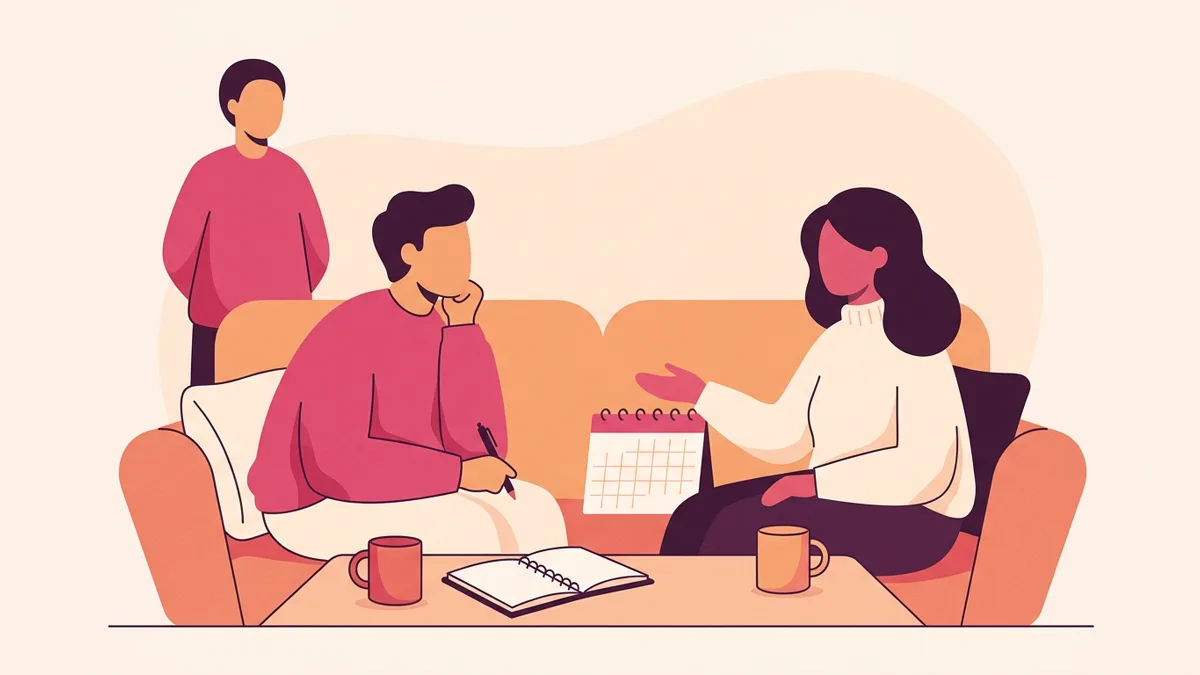
Opening a monogamous relationship can feel both exciting and overwhelming. This guide offers a practical, research-informed path for couples who want to explore consensual non-monogamy with honesty and care. You'll find conversation starters, boundary-setting tips, and ways to navigate jealousy—no pressure, just clear steps.
Key takeaways
- Start with self-reflection and honest conversation before making any changes.
- Consent from all partners is non-negotiable.
- Expect jealousy; learn to manage it through open communication and self-awareness.
- Create clear agreements about boundaries, hierarchy, and safer sex.
- Revisit and adjust your agreements regularly.
What an Open Relationship Actually Means
An open relationship is an intimate relationship in which partners agree to at least the possibility of sexual or emotional intimacy with other people[1]. This can apply to dating relationships as well as marriages, and the idea has been discussed openly since the 1970s[1]. However, open relationships are not a single fixed model; they can include swinging, where committed partners engage sexually with others at the same time, or other arrangements that suit the people involved[1]. It is also distinct from polyamory, which involves having more than one intimate relationship at a time with everyone’s knowledge and consent[1].
How common is this? In a 2012 national survey, 4% of respondents said they were in an open relationship[1]. The same survey found higher percentages among gay men (33%), bisexual men (23%), lesbian women (5%), and bisexual women (22%)[1]. These numbers show that while open relationships are not the majority, they are a real and recurring choice for many adults.
Reflect on Your Motivation Before Starting
Before you bring the topic to a partner, take time to understand your own reasons. Are you looking for more sexual variety, deeper emotional connections, personal growth, or something else? There is no single correct motivation, but honesty with yourself will make the next conversations easier. If your main goal is to repair a relationship after infidelity, be especially careful: a mono-poly relationship can be healthy when both partners get their needs met, but it can become codependent if it is used to save a relationship after cheating[5].
You might also want to talk with a therapist at this stage. Seeing a couple’s therapist can be a helpful step before opening a monogamous relationship[5]. A therapist can help you and your partner untangle fears, hopes, and assumptions before any rules are set.
Start the Conversation and Keep It Going
Consent from all parties is crucial in ethical non-monogamy[5]. That means no one should feel pressured or rushed into an agreement. When you first raise the topic, choose a calm, private moment and use 'I' statements. For example, you might say, 'I’ve been thinking about what it would mean for us to open our relationship, and I’d like to understand your feelings.' Then listen without interrupting.
Open and honest discussion is essential for establishing rules and boundaries[5]. Partners should share their wants, needs, and boundaries with an open mind and without judgment[5]. This is not a one-time talk; it is the beginning of an ongoing dialogue. Some couples find it helpful to schedule regular check-ins, separate from date nights or stressful moments, to revisit how things are going.
- What does 'open' mean to each of us?
- Which activities or emotional connections feel okay, and which feel off-limits?
- How much detail do we want to share about other partners?
- What are our safer-sex expectations?
Build Agreements, Boundaries, and Safer Sex Plans
Couples in open relationships often use negotiation tools such as allowing partners to veto new relationships, asking for prior permission before a date, or interacting with each other’s partners[1]. These are not mandatory; they are options you can adapt to your own needs. The most important principle is that the arrangement fits the needs of all parties involved[1].
Research on consensual non-monogamy has identified nine common practices that help people maintain multiple relationships[2]. They include disclosing extra-pair attractions to a partner, talking openly about jealousy, cultivating compersion (joy in a partner’s joy), being willing to care for unrelated children, sharing extra-pair sexual experiences, deciding on partner hierarchy or non-hierarchy, maintaining sexual health, distributing time and resources thoughtfully, and managing reputation[2]. In one survey, each of these practices had distinctive associations with relationship quality and satisfaction[2]. You don’t need to adopt all of them, but discussing them can clarify expectations.
Safer sex is a practical area that deserves careful planning. Talk about STI testing frequency, barrier use, and what to do if a condom breaks or a partner has a new exposure. Because sexual health needs vary, it is wise to speak with a qualified clinician who understands non-monogamy for personalized advice.
Prepare for Jealousy and Learn Compersion
Jealousy is a common worry, and it is not a sign of failure. Some research suggests that people in open relationships report less jealousy than people in monogamous relationships[1], but jealousy still appears. In one early study of open marriages, 80% of participants had experienced jealousy at some point[1]. More recent work found that monogamous individuals reported greater emotional distress when imagining a partner’s extradyadic involvement, while consensually non-monogamous individuals thought about their partner’s outside relationships more frequently[3].
This means you may think about your partner’s other connections often, but that does not have to be distressing. Open communication about jealousy is one of the nine maintenance practices[2]. Compersion, or feeling glad when a partner experiences joy with someone else, is another practice that can be developed over time[2]. Practical steps include naming the specific fear behind jealousy, asking for reassurance without demanding your partner cancel plans, and creating a self-soothing routine.
It can also help to remember that hierarchy matters to some people. In hierarchical arrangements, primary partners take priority over secondary partners, while non-hierarchical setups treat partners more equally[5]. Knowing where you stand can reduce uncertainty.
Start Slowly and Revisit Your Agreements
There is no prize for moving fast. Healthline advises talking with a partner first and taking things slowly when thinking about opening a monogamous relationship[5]. You might begin with a trial period—say, three months—where you only flirt or go on casual dates, then check in. Use that time to see how each of you feels in practice, not just in theory.
Research has not found that open marriages are inherently less satisfying. Some studies have found no differences in marital satisfaction between couples in open marriages and sexually monogamous couples[1]. Another study reported that 76% of couples in open marriages described their relationship quality as above average or outstanding[1]. These findings are not a guarantee, but they suggest that with care, open relationships can be fulfilling.
Revisit your agreements at regular intervals—monthly or quarterly—and adjust what is not working. A successful open relationship is not static; it evolves as the people in it grow.
Seek Support When You Need It
You do not have to figure everything out alone. Seeing a couple’s therapist can be a helpful step before opening a monogamous relationship, and it remains useful after you have started[5]. Look for a therapist who is familiar with consensual non-monogamy, if possible. Support can also come from trusted friends, community groups, or books written by experienced non-monogamous people.
Finally, remember that your relationship is unique. The tools and agreements that work for one couple may not work for you. The key is honest communication, mutual consent, and a willingness to keep learning together.
Frequently asked questions
Is an open relationship the same as polyamory?
No. An open relationship is an agreement to allow at least the possibility of sexual or emotional intimacy with other people, while polyamory specifically involves having more than one intimate relationship at a time with everyone’s knowledge and consent[1]. They overlap but are not the same thing.
How common are open relationships?
In a 2012 national survey, 4% of respondents reported being in an open relationship[1]. Rates were higher among gay men (33%), bisexual men (23%), lesbian women (5%), and bisexual women (22%)[1].
Will opening our relationship get rid of jealousy?
Not necessarily. Some research indicates that people in open relationships may report less jealousy overall, but jealousy still occurs; one early study found 80% of open-marriage participants had experienced jealousy[1]. Open communication about jealousy is a key maintenance practice[2].
Should we see a therapist before opening up?
It can be very helpful. Seeing a couple’s therapist is a suggested step before opening a monogamous relationship[5]. A therapist can help you and your partner clarify needs, fears, and boundaries.
Sources
- Open relationship – Wikipedia. https://en.wikipedia.org/wiki/Open_relationship
- Mogilski et al. (2026). How Do People Maintain Consensual Non-Monogamy? An International Development and Validation of the Multiple Relationships Maintenance Scale. Archives of sexual behavior. PubMed. https://pubmed.ncbi.nlm.nih.gov/41840193/
- Mogilski et al. (2019). Jealousy, Consent, and Compersion Within Monogamous and Consensually Non-Monogamous Romantic Relationships. Archives of sexual behavior. PubMed. https://pubmed.ncbi.nlm.nih.gov/30607710/
- Hoff et al. (2012). Relationship characteristics associated with sexual risk behavior among MSM in committed relationships. AIDS patient care and STDs. PubMed. https://pubmed.ncbi.nlm.nih.gov/23199191/
- Your Guide to Polyamorous RelationshipsHealthline – Healthline. https://www.healthline.com/health/relationships/polyamorous
Facts in this article were taken from the sources above and rewritten in our own words. See our editorial policy. Found an error? Tell us.